The folks at the ITU (International Telecommunications Union) have been publishing a series of reports about the internet since 1997. The latest, from December 2006, is called digital.life.
As they describe it:
. . . the 8th in the series of ITU Internet Reports, entitled digital.life, begins by examining the underlying technologies for new digital lifestyles, from network infrastructure to value creation at the edges. In studying how businesses are adapting to fast-paced digital innovation, the report looks at how they can derive value in an environment driven by convergence at multiple levels. Moreover, a great challenge lies in extending access to underserved areas of the world. In light of media convergence, a fresh approach to policy-making may be required, notably in areas such as content, competition policy, and spectrum management. And as our lives become increasingly mediated by digital technologies, digital identities (both abstract and practical) take on a new dimension. Concerns over privacy and data protection do not seem to be sufficiently addressed by today’s online environments. In this context, the report examines the changing digital individual, and outlines the need for improving the design of identity management mechanisms for a healthy and secure digital world.
It’s well worth a quick read, if “quick” can be applied to a 135 page report by an NGO (and that’s without the detailed statistics, which are available for purchase).
One graph from the report I found interesting shows the migration of media to digital formats:
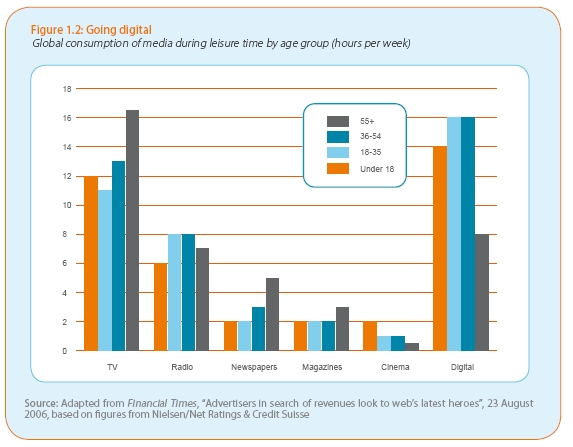
But what would “digital” mean in this context? If I watch digital cable, is that TV or Digital? If I listen to the radio but it is KEXP from Seattle streaming over the web, is that Radio or digital? If I read the NY Times or the Wall Street Journal, but do so online, is that a newspaper, or digital?
Is digital a delivery format, in the sense that the content comes to me as bits (ones and zeros) rather than printed on paper or broadcast over the airwaves?
