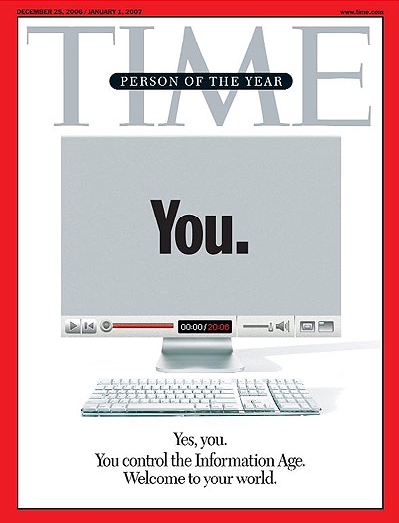
 As you’ve probably already heard, you’ve won Time magazine’s “Person of the Year” for 2006. Well, not you specifically, but “You,” the abstract
 third-second-person plural pronoun.
(Perhaps really it should be Y’all who were awarded People of the Year, but I don’t think their editors would allow that. Dan Gillmor at the Center for Citizen Media Blog suggests it should be “Us,” so as not to perpetuate the distance between traditional media and end users, but it would be strange to me to see Time declaring itself part of that particular “Us.”)
The “You” in this case wasn’t the abstract American public, though perhaps they could have been given the nod for the recent mid-term elections and the shift in policy it likely will represent, but specifically those of you/us who have contributed something to the Web. Time proclaims that the main story of 2006:
“isn’t about conflict or great men. It’s a story about community and collaboration on a scale never seen before. It’s about the cosmic compendium of knowledge Wikipedia and the million-channel people’s network YouTube and the online metropolis MySpace. It’s about the many wresting power from the few and helping one another for nothing and how that will not only change the world, but also change the way the world changes.” (emphasis added)
Isn’t it something of a long leap from YouTube and MySpace to “the many wrestling power from the few”? They do go on to note that “Web 2.0 harnasses the stupidy of crowds as well as its wisdom,” which is I suppose the necessary counterpoint to the revolutionary rhetoric in the above.
In the “Power to the People” article, the Time editors point to 15 specific examples of those who contributed to the user generated content revolution. Unfortunately, it’s a pretty mixed bag for anyone interested in the critical potential of citizen-driven media:
- Leila, the “real” Lonelygirl15
- Lane Hudson, the blogger who broke the Mark Foley scandal
- Ali Khurshid, a Pakistani who posts pictures to Flickr
- Megan Gill, a Facebook user.
- Lee Kelley, a military blogger from Wordsmith At War
- S. R. Sidarth, the person George Allen called “Macaca” on video
- Waz and Lenny from Crash Test Kitchen
- Harriet Klausner, the author of 12,896 book reviews on Amazon
- Wang Xiaofeng, “the most respected blogger in China”
- Tila Tequila, “The Madonna of MySpace”
- Smosh, posters of comedic videos to YouTube
- Kamini, a French rap artist who posted his own song online
- Simon Pulsifer, author of “between 2,00 and 3,000 Wikipedia articles” and editor of “roughly 92,000 others.”
- Kim Hye Won, a reporter for OhMyNews
- Blake Ross from the Firefox project
Nice to see some acknowledgements of places where user contributed video was something other than a cloaked ad campaign, someone dancing to the latest top 40 hit, or yet another video of a laughing baby.
By focusing on the broadest set of issues, though, Time seems to have missed a good opportunity to talk about where the real impact of user-driven media will or will not be.
Where were the links to places like OurMedia, NewAssignment, The Independent Media Center, and the Center for Citizen Media?
What happened to the many seizing power from the few?
Is it expecting to much from a mainstream media story about user contributed content that it would point the way towards something better than just America’s Funniest Videos without a decent editor?

And they mention two Flickr users Ali Khurshid and Lavannya Goradia but don’t provide links (unless I am blind)to their work.
Yeah–and what happened to Hugo Chavez who topped the poll only to be totally ignored by TIME?
Quote: «…not you specifically, but “You,†the abstract third-person plural pronoun»
————-
Isn’t it the SECOND-person?
D’oh! (Homer Simpson noise here)
You’d think a PhD in English (that’s me) would remember his first, second, and third person pronouns.
You, as in the second-person plural pronoun.