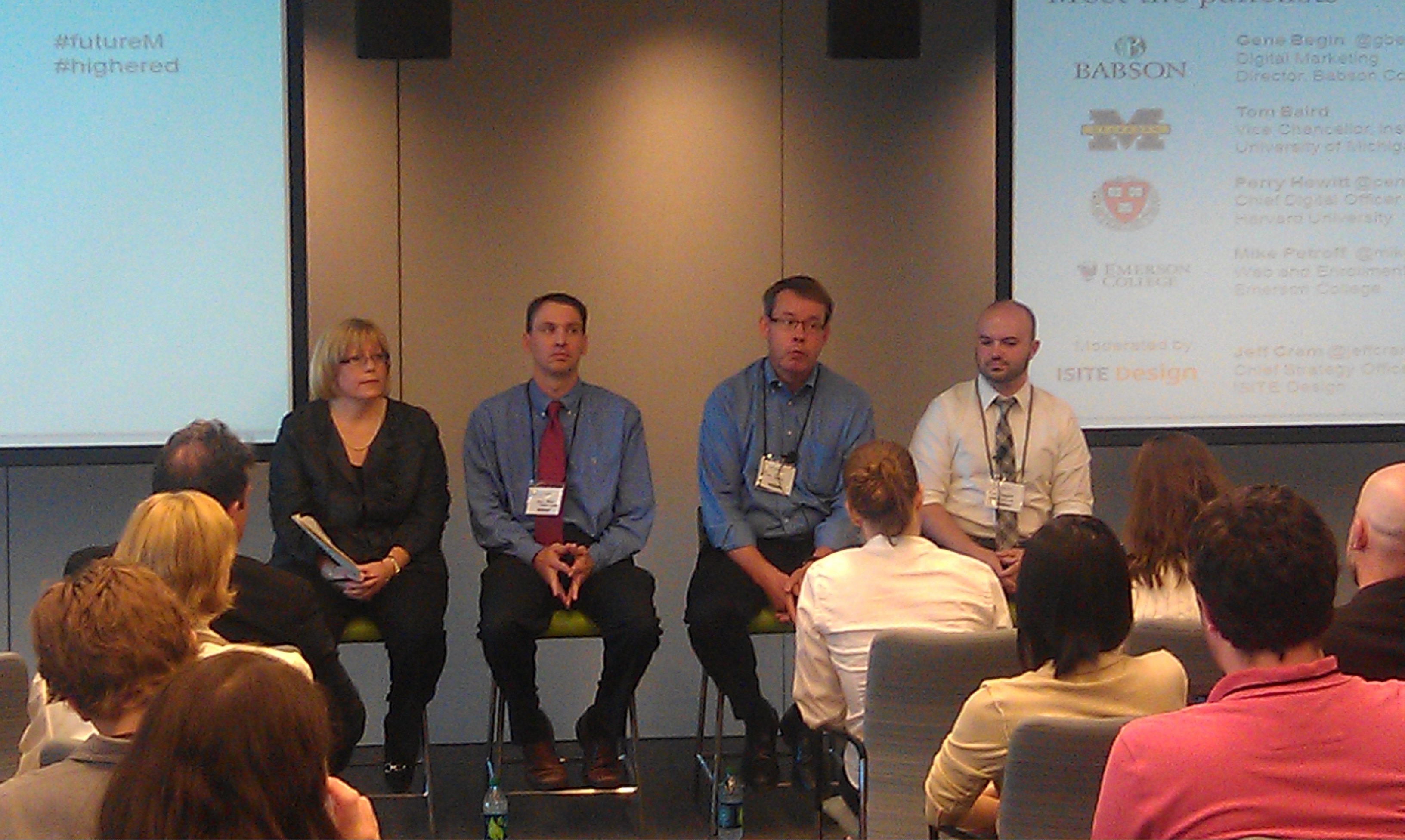
In support of our higher education practice, ISITE Design sponsored a panel at FutureM titled “Beyond the University Website: The Future of Digital Marketing in Higher Education.” Jeff Cram moderated, and participants included (from left to right in the photo):
McIntyre Medical Building (Photo by un flaneur, cc-by-nc-nd license)
DrupalCamp Montreal was this past weekend, and the videos are already posted! The event venue was McGill University’s McIntyre Science Center, which is equipped with an automated system to capture lectures at specific times.
The system captures the video output being projected as well as video of the lectern where the speaker is standing, and makes the files available on a predetermined url. (I found that the “webcast” view with slides and speaker both visible sometimes failed in Firefox but worked in Chrome – unfortunately it’s silverlight based).
There’s been lots of industry buzzz about Time Warner and Comcast’s TV Everywhere plan, which would allow subscribers to fixed-wire cable offerings access to premium content over internet connections, freeing content from the cable box (or cable card). Although it isn’t exactly setting content free on the web, it does seem a positive step in the direction of moving beyond the cable box and cable as the only distribution mechanism for certain kinds of premium content. Users want greater control of what they watch, when they watch it, and where they watch it: TV Everywhere falls short of giving complete control but takes a step in the right direction.
Earlier this month, Comcast launchedFancast XFinity, their branded name for their version of TV Everyehwere. Essentially, XFinity is a distributed authentication system, in which users prove their association to an existing cable subscription, and receive corresponding entitlements to an online video catalog. Read more…
Highlight of OMMA Global day one for me was Terence Kawaja of GCA Savvian, whose presentation included a verse by verse playing and discussion of his own satirical song “Mad Avenue Blues” (sung to the tune of “American Pie,” with the refrain changed to “The Year the Media Died”).
Like the original, it’s long (9:21 in this case) and as Kawaja said in presenting it, lends itself to the elegiac mode – he wouldn’t quite say media is dead but it’s hard to write a catchy lyric about the era in which large mainstream media companies faced downward revenue pressure:
Interesting video for the luncheon keynote at a conference on online media, marketing, and advertising – but it hits on much of the industry’s current malaise.
The good news, such as it is, is that John Battelle challenged Kawaja to write an upbeat song on the state of the media – send your suggestions to @tkawaja.