ROFLCon Panel – Internet Fame

Weinberger also (see previous post) stayed to moderate a panel on what it means to be internet famous.

Panel description:

YOU CAN GET PAID FOR THIS?: MAKING SOME BUCKS (W20: Sala del Puerto Rico): How do you make money? Are you making lots of money? Has all that money corrupted you? How about now? Are you a fluke are you generalizable? What are some other ways the rest of us can make money? Please?

Moderator: David Weinberger

Panelists: Kyle Macdonald (One Red Paperclip), Joe Mathelete (Joe Mathelete Explains Marmaduke), Ian Spector (Chuck Norris Facts), Andy Ochiltree (JibJab.com), Andrew Baron (Rocketboom), Alex Tew (The Million Dollar Homepage)

My rough rough notes:
(Mostly these notes don’t reflect how good Weinberger is as a moderator with an unpredictable crowd, including the panelists – he did a great job getting them to answer questions without getting in the way of their natural humor and randomness.)
Continue reading →

Weinberger at ROFLCon: Fame in the age of ubiquity

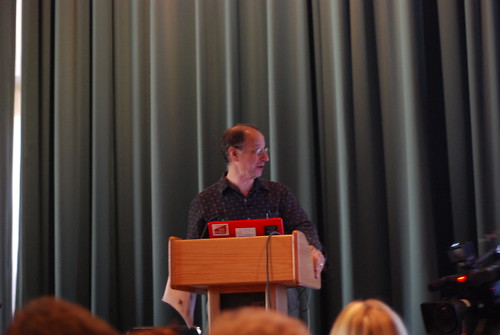
David Weinberger, whom I’m a clear fan of to anyone who reads this bog, was the keynote speaker this afternoon at ROFLCon, which the organizers pronounce like roffle-con, not spell out like R – O – F – L- con, which is how I pronounce it.

Weiberger at ROFLCon
(Photo by kevingc on flickr, creative commons attribution non-commercial share alike license).

See my rambling notes below:

He basically argued (riffing on many themes from Everything is Miscellaneous) that the internet has changed the nature of fame – that in the pre-internet, mass communications era, fame was incredibly scarce, and drew it’s power from scarcity – very few people could make someone famous, and the number of ways to become famous was very small.

This created a certain kind of fame we call celebrity, along with a bunch of notions of what that means.

But thanks to the internet, we are no longer are interested in the inhuman, they’re-not-like-us-they’re-so-different famous – we’re looking for real, homespun, authentic, not separate, one of us kind of famous.
Continue reading →

BarCamp Boston 3

Shimon Rura’s email today reminded me that BarCamp Boston is fast approaching again. Third week in May we should easily avoid the snowstorm which put something of a crimp in BarCamp Boston 2.

BarCamp Boston 3

In case you’ve been somehow able to escape the increasing presence of *camps, BarCamp is one of the earliest and one of the best. It was on the occasion of BarCamp Boston (the original) that I started blogging, though to be fair you shouldn’t hold them responsible for that.

Here’s an hCalendar microformat of the event info:

May 17th 08am, 5pm 2008 – BarCamp Boston 3– at Matignon High School, 1 Matignon Road, Cambridge,
MA 02140 U.S.A.


BarCamp is an unConference, organized on the fly by attendees, for attendees.

There is no registration fee, but you don’t just attend a BarCamp — you can participate in discussions, demo your projects, or join into another cooperative event.

Topics may include, but are not limited to: open source software, startups, UI design, entrepreneurship, AJAX, hardware hacking, robotics, mobile computing, bioinformatics, RSS, Social Software, programming languages, and the future of technology.

Read more about BarCamp, view schedules, and learn how you can participate, by visiting the wiki at http://2008.barcampboston.org/.

WordPress to Facebook and Back Again

I was really intrigued by Dave Lester‘s WPBook plugin, which lets you bring posts from your wordpress blog into an application in Facebook.

I really wanted, though, for users to be able to comment on blog posts from inside Facebook, with their Facebook identities, and have it work like the OpenID comment plugin (in the sense that the user should not need to provide any authentication info, but it should be derived from their Facebook login).

I think I’ve finally got it it nailed, at least to the point where folks can start testing it.

If you are a Facebook user, go to this application page: http://apps.facebook.com/openparenthesis/

It will require you to log in (or already be logged in) to Facebook, but you don’t have to add the application to your profile or spam all your friends.

What you’ll see is my five most recent blog posts from this blog, inside a Facebook wrapper. (Can’t include embedded videos, the styles are bit wonked, etc – but it is a start. This is basically just Dave Lester’s plugin).

You should also (this is the new part I’ve hacked in) see the ability to comment on posts – without being asked for a name or url or email address.

Please leave me a comment to test it out. It should, if all works according to plan, pull your Facebook profile pic as your avatar for the comment as well – since your facebook profile page is actually an hCard with appropriate markup (go microformats!).

I believe this will work even for folks who are not “friends” of mine in facebook – but let me know if you run into difficulty.

Once I’ve validated that it works I’ll publish the code. It required me to add at least one file to my theme, and relies on the hAvatar plugin to get the profile pic.

Known Issues:

Sometimes the “autoresize iFrame to content size” bit in Facebook fails, and you end up with a fixed size view into longer content, with no scrollbars. Haven’t figured out what triggers that yet – standard facebook javascript api.

Sometimes you’ll get the “You’re entering comments too fast” error – just wait 30 seconds. Unless lots of people are all trying to do it from facebook at once this should go away. I’ll need to figure out how to unthrottle the comment queue in wordpress for this point.
Google OpenID

(via David Recordon)

OpenIDGoogle App Engine

Ryan Barrett, one of the developers on the Google App Engine team, has released an application which allows you to use your Google Account as an OpenID.

Once you’ve logged in to your Google account, you just use:

http://openid-provider.appspot.com/yourgoogleusername

On any site which relies on OpenID for validation.

So now Yahoo!, AOL, and Google have (direct or indirect) mechanisms for providing OpenID (and Microsoft has committed to doing so in the future).

Combined with all the free, purpose-built OpenID providers (like ClaimID, MyID, MyOpenID, MyVidoop, and Clickpass) and it looks like 2008 could be the tipping point (assuming one hasn’t already occured in 2007).

(See OpenID Status Check for a recent, and more exhaustive list).