[Update Tuesday June 19 – the streaming video and Mp4 download are now available as well – thanks to Frogpond for the links.]
I kicked off my Enterprise 2.0 experience this morning by attending the much ballyhood “smackdown” between Harvard Business School professor Andrew McAfee and Babson professor Tom Davenport (see Davenport v. McAfee update or the coverage on Social Computing Magazine).
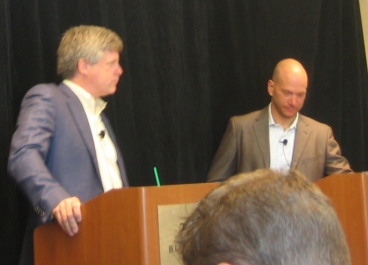
I’m not much of a live blogger, but here’s my raw notes from the debate – which turned out, as such debates often do, to be more filled with violent agreement and relatively nuanced distinctions between positions than it was with rancor or hostility. (It never fails when both participants are reasonable, articulate, intelligent folks).
The debate was moderated by Dan Farber, webcast live on Veodia (no archive available yet so far as I know), and sponsored by BSG Alliance.
(In what follows, DF = Dan Farber, AM = Andrew McAfee, TD = Tom Davenport, and E2 = Enterprise 2.0 – note these are very quick notes, not a transcript, so errors will occur).
DF: Tom, why is E2 the next small thing?
TD: I have yet to see capitalist organizations make more money as a result of E2, or any examples of corporate cultures being revolutionized. I see no problem with the definition of using web 2.0 technology in enterprises, but that begs the question of what web 2.0 is. What I have a problem with is the idea that E2 represents a whole new style of enterprise – given that we’ve had enterprises for thousands of years. I’m an agnostic, not an atheist on this.
AM: On that we actually agree. I’m fairly sure that it will not be trans formative for many enterprises. There is, however, a real discontinuity from a technology perspective – the technology is capable of so much more than it was previously. It’s the fact that anyone can contribute to it – from anywhere in the organization – and the wisdom that comes out of the collective pattern which emerges which is the new thing. Free form, emergent, without structure added in at design time.
Continue reading →
 If you’ve tried to visit this blog in the last few weeks, sorry.