David Weinberger, whom I’m a clear fan of to anyone who reads this bog, was the keynote speaker this afternoon at ROFLCon, which the organizers pronounce like roffle-con, not spell out like R – O – F – L- con, which is how I pronounce it.
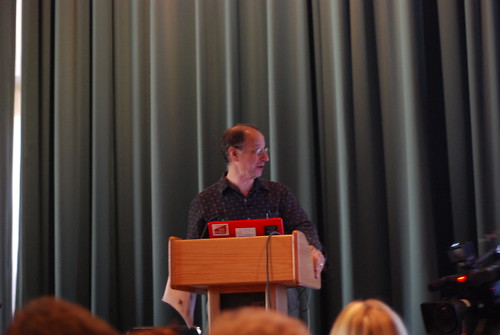
(Photo by kevingc on flickr, creative commons attribution non-commercial share alike license).
See my rambling notes below:
He basically argued (riffing on many themes from Everything is Miscellaneous) that the internet has changed the nature of fame – that in the pre-internet, mass communications era, fame was incredibly scarce, and drew it’s power from scarcity – very few people could make someone famous, and the number of ways to become famous was very small.
This created a certain kind of fame we call celebrity, along with a bunch of notions of what that means.
But thanks to the internet, we are no longer are interested in the inhuman, they’re-not-like-us-they’re-so-different famous – we’re looking for real, homespun, authentic, not separate, one of us kind of famous.
Examples:
Mahir I kiss you. 1999. *we* made him famous. Not orchestrated by any media conglomerate. (Some people may be condescending here, some not).
Dancing hamsters.
Star wars light sabre kid. (Here there’s definitely condescension, not us at our finest – we’re laughing at him).
These are all things we made famous.
We’ve invented a way to scale conversation – loosing a lot, gaining some. Conversation will fill every vacuum.
Everyone now is famous to 15 people.
We know how fame works in a time of scarcity but not in a time of abundance – now that everyone can recommend media, not just famous people, what does famous look like?
There are more people who are sortof famous – we’re lengthening out the elbow in the power-curve graph of fame – not exactly a long tail, but a thicker elbow and a somewhat thicker tail. More complex, more continuum, more stops along the way between famous and unknown. [My addition – what Kathy Sierra might call a high resolution experience of fame].
The obama bollywood remix.
The “a thousand true fans” concept – basically fame on line softens the power curve in the direction of a continuum.
We’re maing people famous in lots of new ways – one to a few, one to a lot, anonymous fame, pseudonymous fame, mimicing, mocking, mimocking? evanescent, persistant, stupid brilliant mean knowing polished confused confusing
Fame on the internet is human. It’s messy and complicated, just like us.
