Google’s maps application is now available for Windows Mobile Smartphone edition based phones, like my Cingular Blackjack (Samsung i607):
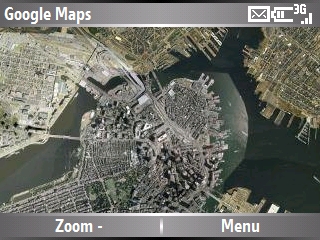
Google’s maps application is now available for Windows Mobile Smartphone edition based phones, like my Cingular Blackjack (Samsung i607):
Version 1.0 of the ODF translator for Word has been released.
32-Bit Windows only (NT, 2000, XP)
Per the announcement on the project’s SourceForge page:
It has been tested over Word XP, Word 2003 and Word 2007 in five different languages (English, Dutch, French, German and Polish) . . .
We’are also planning to work on Excel and Powerpoint and this should be availble by the end of the year (Novembre 2007), so stay tuned and keep on providing feedback as this will help us in future development!
This is actually quite helpful for me, since I dual boot between Kubuntu and Windows, and work in a mixed platform environment – basically I use OpenOffice when in Linux and MS Office when in Windows – rather than having to install OpenOffice for Windows in addition to my OpenOffice for Linux, now I can more easily move back and forth.
The January 2007 Communications of the ACM had an article by Jaap-Henk Hoepman and Bart Jacobs: “Increased Security Through Open Source.” (PDF or PostScript).
The authors argue that:
. . . using open source software is a necessary requirement to build systems that are more secure. Our main argument is that opening the
source allows independent assessment of the exposure of a system and the risk associated with using the system, makes patching bugs easier and more likely, and forces software developers to spend more effort on the quality of their code.
I’ve blogged before about the PEW Internet and American Life project – it’s a fantastic resource, and anyone interested in the future of the web in the U.S. (which means anyone concerned about the future of the U.S.) ought to subscribe to their reports and publications.
The Pew Research Center, which is the parent organization of the IAL project, just launched a major redesign of their site. It looks great – nicely surfaces new research and specific findings while also giving a sense of the breadth of their concerns.
The IAL project itself released yesterday a new report on tagging: “Tagging Play: Forget Dewey and His Decimals, Internet Users Are Revolutionizing the Way We Classify Information – and Make Sense of It.”
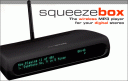 A number of years ago I came across a device called a Squeezebox, made by a company called Slim Devices. The first-generation model, which I bought, is pictured at the left. (There was also device called a Slimp3 which preceeded the Squeezebox).
The device sits with your stereo, connects to a wireless network (802.11b in the case of the first generation box), finds a computer running the SlimServer, and takes audio streams from that server to your home stereo.
In and of itself, that was cool enough for me. The SlimServer software (latest release, nightlies) is cross platform and open source – so that if you don’t like the way it handles, for example, multi-disc sets, you can change it, and contribute your changes back to the community (forums, wiki, bug tracker). (It’s Perl, and in the current versions uses MySQL to store library information – does very well even with large library sizes).
There’s even a Java application, SoftSqueeze, which emulates the hardware client, so you can experience the whole thing without buying any hardware. (CharlesV has created a mashup using Netvibes along with the Slimserver – one of the unintended uses to which an open source server can be put). Now they’ve created the Transporter, a high-end ($2000 list) audio device based on the same concept, but with “audiophile” quality components.