Don’t Make Me Decide Yet: Lowering the Barrier to Entry

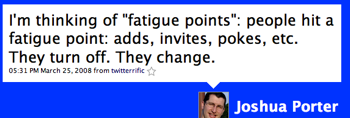
A few days ago Josh Porter was tweeting about the notion of “fatigue points”:

fatigue points

I think it’s a very useful concept, pointing out that people’s decisions aren’t binary: it isn’t a single yes/no decision but an active, ongoing negotiation, which determines which services you use and don’t use.

You can also think about the barrier to entry of a new user in a similar fashion. Any time you try out a new application or service there are a few barriers, and whatever the application developer can do to lower those barriers the more users will get over that threshold.
Continue reading →

One way openness, or learning to spit as well as suck

TechCrunch wrote last week about changes Facebook made to the news feed:

Facebook is planning on allowing users to add activities from third party social networking site directly into their Facebook news feed, we’ve confirmed.

The problem is that their only talking about allowing users to *add* activities into the news feed, not to take their facebook news feed and take it elsewhere. As TechCrunch put it:
Continue reading →

Automated Import to Dopplr from TripIt

I use both TripIt and Dopplr, as each is better at certain things than the other.

In my ideal world, the act of forwarding a travel confirmation to TripIt, which establishes a trip, would also create the same trip in Dopplr, which my Dopplr badge, news feed on Facebook, Fire Eagle account, and lifestream would then share with the public, abstracting the details of flights and hotels and such. (Not that I’m terribly worried one could discover them, but just to simplify as Dopplr does well, so that only those who actually want to connect need to get to the details).

That possible crept a bit closer as Dopplr announced the ability to subscribe to your Google Calendar and learn your trips from it.

For some time, Dopplr has been able to export trips to calendars; TripIt can also adds trips to a calendar, but does so in a much more precise fashion, actually adding the flight info and such.

[Update: I had originally posted that the format Dopplr expects is different enough from the one TripIt produces that the two cannot be linked. I was wrong – they can be.]

To link your TripIt account to your Dopplr account, log in to TripIt and locate your iCal feed on your “MyTrips” page (click on the green ICAL feed icon):

TripIt iCal

Then, log in to Dopplr, go to “Your Account” and choose “Import trips from external calendars.”

Paste in the address of your TripIt iCal feed and Voila! – automated import of TripIt trips into Dopplr.

The logic is smart enough to notice where you already have trips, and not double book you in Dopplr.

Very cool. Now all I need is an Action Stream plugin for Movable Type which notes actual travel segments, so that I can add “John flew from Boston to Austin” to a day like today on JohnEckman.com. I suppose I could write one that checks the iCal feed from TripIt once or twice a day, and creates an action only when the travel date matches today’s date?

State of Drupal

(First part of this week I am attending DrupalCon 2008)

[Update 3/4/08: Audio from the State of Drupal as well as Jay Batson and Dries’ “Presenting Acquia” talk are available on Shai’s podcast]

[Updated again 3/6/08: Video from the State of Drupal at Internet Archive]

Not surprisingly, Dries’ state of Drupal presentation was well received by the crowd of assembled Drupalers.

The state of our union is strong, Dries began, citing the success of Drupal 6 in attracting even broader communities of interest. But as we prepare for the broader audiences that success brings, there are things we need to pay more attention to.

The focus of Drupal 7, as Dries recommended to the community, should be on interoperability and usability. This means improving internal and external APIs, enhancing data portability, and redesigning the home of Drupal, drupal.org, to better accomodate the next wave of users joining the community.

(Great to see a project lead of a major open source community paying so much attention to usability!)
Continue reading →