Freedom in a new context

Tim O’Reilly kicked off the O’Reilly Radar Executive Briefing this morning by talking about the need to “rediscover the values of free and open in a new context.”

He talked about a number of different freedoms, beyond the “free as in beer” and “free as in speech” dichotomy:

  • Freedom to use
  • Freedom to build on and adapt
  • Freedom to participate
  • Freedom to fork
  • Freedom to switch

And then asked a series of thought-provoking questions.

How to we maintain these freedoms in a world in which “runnung the program” requires a data center? (It isn’t about programs I can run on my machine but global web services with enormous data needs)

How do we maintain these freedoms when applications are delivered as services and don’t distribute code?


Now, I want an iPhone

A few weeks ago, my blackjack suddenly decided to reboot itself, and in the process seems to have killed all the registry settings.

In Windows Mobile Terms, it’s like a self-induced frontal lobotomy. My phone no longer knows what applications are installed on it, doesn’t remember how to sync to our exchange server, etc.

After spending two hours last night battling the ActiveSync demons in order to connect my BlackJack to my laptop (in order to install the registry editor and certificate for our exchange server on it), uninstalling and resintalling bluetooth (twice!) in the process, and hacking registry settings to enable ActiveSync to work with our exchange server, I’m done.

Would an iPhone just work, or am I falling into the Apple hype?

Of course, what I really need is an OpenMoko. How long before I can run one of these on Cingular? Can I already?

So Many Conferences, So Little Time

Lots of great conferences going on right now – wish I could be at all of them.

WordCamp
This weekend is WordCamp, in San Francisco. Chz and Tofu from ICanHasCheezburger, one of my favorite blogs, will be there. (Yes, I have a doctoral degree in English and ICanHasCheezburger is one of my favorite blogs. Deal with it.)

The full schedule is online, and it many folks will use trackback to add their blogging about sessions they attended to the session’s page in the schedule.

Some sessions which look to me like highlights I will be sorry to miss:

Definitely a high powered set of speakers and in a relatively intimate forum. I’ll definitely add WordCamp 2008 to my “hopefully attend list.”

Ubuntu LiveStarting this morning is Ubuntu Live, which runs this morning through Tuesday in Portland. Their schedule is also online and also impressive.

(A Sunday morning keynote trifecta with Mark Shuttleworth, Stephen O’Grady, and Jeff Waugh, as the first session of teh conference? Impressive. In fact, O’Grady’s already posted his slides and script.)

OSCON Finally, the rest of the week will be OSCON 2007, which I will be attending.

As usual, OSCON is enormous (check out the schedule – there are literally 15 parallel tracks much of Wed and Thurs), and that’s just the official sessions, not to mention the parties and events.

Drop me a line if you’ll be in Portland next week too.

Convergence, Open Source Style

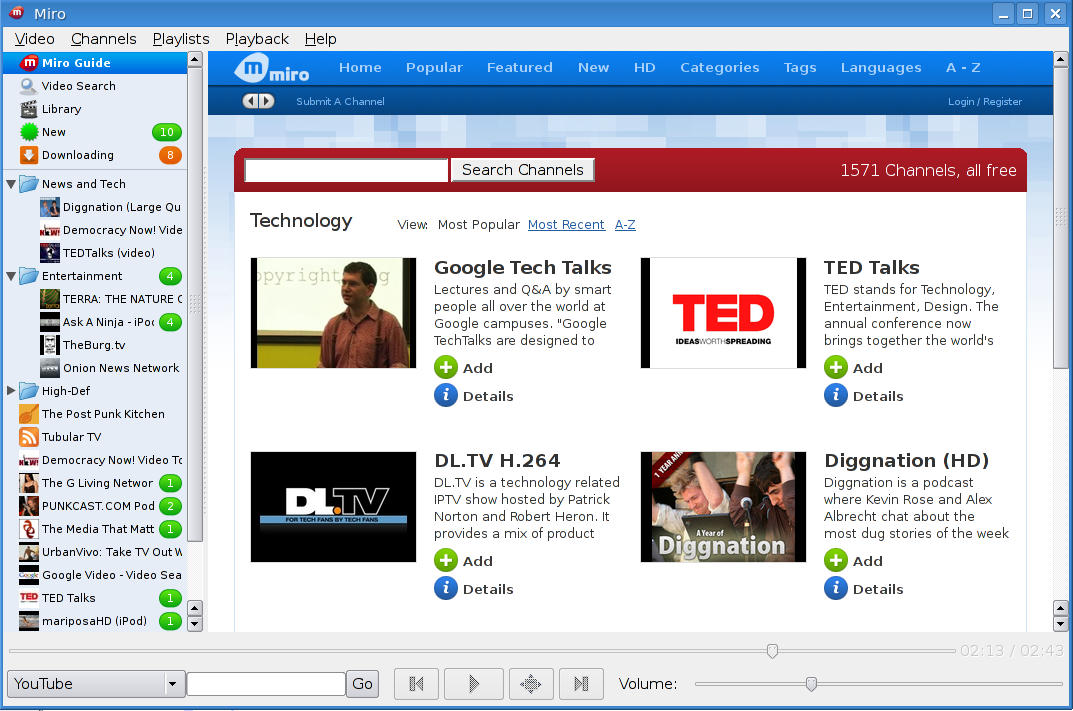
The Free Open Source Internet video platform sponsored by the Participatory Culture Foundation and formerly known as Democracy Player has relaunched as Miro.

Head over to GetMiro and download the Public Preview 1 (v. 0.9.8) release.

Miro

Miro is available for Windows, Mac OS X, and pre-packaged for a number of Linux distros (Fedora, Ubuntu, with Debian and Gentoo coming soon) as well as source code for the true DIY.

Miro lets you:

  • Play virtually any video file, across different platforms
  • Download and play full screen, high definition video
  • Subscribe to video podcasts, video blogs, any rss feed with enclosures
  • Locate new video content using the Miro channel guide
  • Download videos from YouTube, DailyMotion, Google Video and others
  • Download BitTorrent videos and watch them in the same application

Miro’s based on the Mozilla XULRunner framework, and is an excellent example of cross-platform, non-proprietary alternative approach to taking Internet-based applications beyond the browser context, without losing the open, standards based approach that made the web successful in the first place.

Corporate Blogging, Comment Seeding, and Controversy

Jerry Bowles at Enterprise Web 2.0 posted a fairly scathing indictment of Deb Weil and the GlaxoSmithKline corporate blog (clog?) for Alli: Deborah Weil and the Art of the Fake
. Bowles argues:

Deborah Weil has been around the block a couple of times and she must have known when GlaxoSmithKline’s agency approached her to consult on a new flog for its Alli weight-loss product that it was a dishonest, insincere attempt to cash in on the social media craze and that the parameters set for it doomed it to failure.

He’s referring to Weil’s post where she requested of her readers:

head on over to GlaxoSmithKline’s official corporate blog for alli, the first FDA approved, OTC (over the counter) weight loss product. Take a peek and, if you’re inspired, leave a Comment.

Continue reading →