Next Generation of Customer Online Interaction

While most of us in the U.S. were enjoying the day off and the summer sunshine, my colleagues from Optaros Europe were having a webinar: “Enabling the next generation of customer online interaction.”

They discuss a project Optaros did with Swisscom Hospitality Services as an example of the impact next generation Internet applications can have customer interactions, as well as how we think such applications are most effectively delivered.

The presentations from the webinar are now available:

PEW report on broadband adoption – 47% have high speed at home

The PEW Internet and American Life project published an update last week on American’s access to the Internet: Home Broadband Adoption 2007

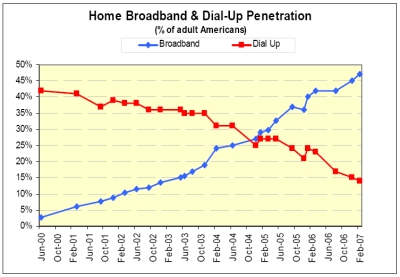
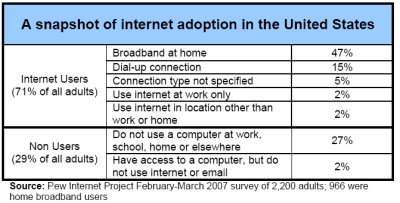
The report finds that nearly half (47%) of all adult Americans now have a high-speed internet connection at home, according to a February 2007 survey conducted by the Pew Internet & American Life Project. The percentage of Americans with broadband at home has grown from 42% in early 2006 and 30% in early 2005. Among individuals who use the internet at home, 70% have a high-speed connection while 23% use dialup.

Or, put visually:

Home Broadband Versus Dialup

The report goes into more detailed breakdowns or rural, urban, and suburban households in terms of broadband versus dialup, and also considers African-Americans and Latinos.

Broadband Snapshot

Download the full report
(pdf)

How many of your friends are juristic persons?

(Updated July 8th)

A corporation is by definition an artificial person, or a legal entity which can act like a person. (Among other things, sue and be sued, make money, enter into contracts, and so on.) If you’re really interested in the legal concept, check out the Wikipedia entry on the notion of a juristic person, especially the section on creation and history of the doctrine.

I’m more interested in the modern, Web 2.0 application of the concept, in which Corporations have profiles on social networking sites.

Delta Airlines, for example, made quite a splash twittering a few months back. I added the twitter Delta Airlines as my “friend” – trusting that Northwest, Jet Blue, and United wouldn’t get jealous – but haven’t heard much from him/her/it recently. In fact, deltaairlines’ last tweet was 1 month ago – “switching on the Nintendo DS download stations at Terminals 2 & 3 in JFK.” His/her/its 103 followers and 93 friends must be sorely disappointed.
Continue reading →

It takes a village – hyperlocal means not going it alone

Jeff Jarvis takes the occasion of the “long-time coming closing” of backfence to talk broady about the Local Challenge:

Hyperlocal will not, I firmly believe, happen at one site. It will work only via networks: content, commercial, social. It will work by gathering, not producing.

In other words, hyperlocal efforts must be based on content aggregation and syndication models, not just content creation models. We need flexible networks for connecting together content producers, advertisers (funding sources), and content publishers.

Jarvis also points to Paul Fahri’s “Rolling the Dice” in the AJR, which asks “is there a real business in this kind of business?,” and answers that “the field as a whole is so far financially marginal.”
Continue reading →